
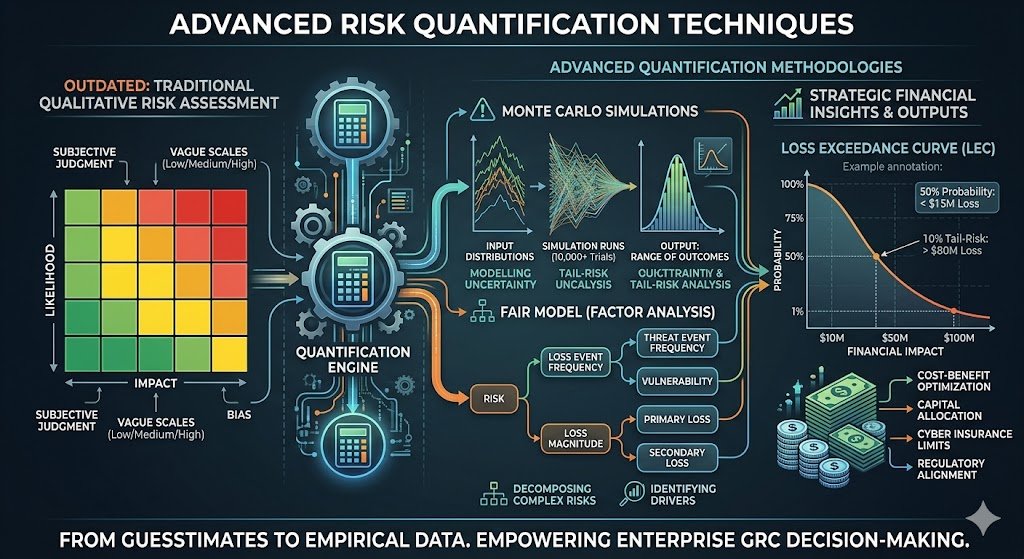
In the contemporary business landscape, organizations are forced to navigate an increasingly volatile, uncertain, complex, and ambiguous (VUCA) environment. Traditional qualitative risk management methods—such as the ubiquitous 5×5 heat map or risk matrix—are rapidly proving insufficient for enterprise-grade decision-making. While qualitative assessment serves a purpose in initial risk identification, it introduces severe cognitive biases, lacks precision, and fails to communicate risk in the universal language of business: financial impact.
To bridge this gap, modern Risk, Governance, and Compliance (GRC) frameworks are shifting toward Advanced Risk Quantification (ARQ). By applying rigorous mathematical, statistical, and computational models to uncertainty, risk quantification transforms abstract threats into empirical data. This essay explores the core methodologies of advanced risk quantification, their practical applications in enterprise governance, and the strategic advantages they offer over legacy qualitative approaches.
1. The Limitations of Qualitative Risk Assessment
For decades, organizations have relied on ordinal scales (e.g., Low, Medium, High) to score risk likelihood and impact. However, qualitative risk assessment suffers from inherent flaws that can actively misinform executive leadership:
- Range Compression and Flaws of Averages: A risk scored as a “4” in impact could represent a $5 million loss or a $50 million loss depending on the assessor’s perspective. It aggregates vastly different magnitudes into a single bucket.
- Sub-optimization: The product of two ordinal numbers (e.g., Likelihood 3 × Impact 4 = 12) is mathematically invalid. It creates an illusion of precision while distorting the actual risk hierarchy.
- Cognitive Bias: Qualitative assessments are highly susceptible to subjective interpretation, anchoring bias, and the “recency effect,” where top-of-mind events skew risk ratings.
Advanced risk quantification strips away subjectivity by replacing ambiguous labels with probabilistic financial distributions.
2. Core Methodologies of Advanced Risk Quantification
Advanced risk quantification relies on empirical frameworks and statistical modeling to simulate how risks materialize and compound. The two most prominent methodologies driving the industry today are The FAIR Model and Monte Carlo Simulations.
The FAIR Framework (Factor Analysis of Information Risk)
The FAIR framework is the international standard for quantifying information security and operational risk. Unlike traditional frameworks that treat risk as an isolated variable, FAIR breaks risk down into its foundational components, defining risk strictly as the probable frequency and probable magnitude of future loss.
                           [ Risk ]
                              │
             ┌────────────────┴────────────────┐
     [ Loss Event Frequency ]         [ Loss Magnitude ]
             │                                 │
     ┌───────┴───────┐                 ┌───────┴───────┐
[Threat Event]  [Vulnerability]   [Primary Loss]  [Secondary Loss]
  Frequency
By decomposing risk into discrete factors—such as Threat Capability, Resistance Strength, Primary Loss (direct assets), and Secondary Loss (reputational, legal, and regulatory penalties)—FAIR allows risk professionals to gather targeted data points even when historical data is scarce.
Monte Carlo Simulations
Because risk is inherently uncertain, it cannot be represented by a single fixed number. Advanced quantification utilizes Monte Carlo simulations to run tens of thousands of algorithmic trials, modeling the full spectrum of potential outcomes.
Instead of asking, “Will we suffer a data breach this year?”, a Monte Carlo model asks, “Given our current controls, what is the probability distribution of breach costs over the next 12 months?” The output is typically visualized as a Loss Exceedance Curve (LEC), which explicitly illustrates the probability of losses exceeding specific financial thresholds (e.g., There is a 10% chance that operational losses will exceed $25 million in FY26).
Bayesian Inference and Expert Calibration
A common critique of quantitative modeling is the “lack of data.” Advanced techniques overcome this through Bayesian statistics, which allow organizations to update the probability of a hypothesis as more evidence or calibrated expert judgment becomes available. By training subject matter experts to provide un-biased, calibrated range estimates (e.g., an 80% confidence interval that an outage will last between 2 and 8 hours), organizations can build highly accurate models even with sparse historical telemetry.
3. Strategic Applications in Enterprise GRC
Implementing advanced risk quantification shifts GRC from a reactive, checking-the-box compliance exercise into a proactive driver of corporate strategy.
Cost-Benefit Optimization of Security Controls
When a security or compliance team requests a $1 million budget for a new technical control, qualitative frameworks cannot justify the ROI. ARQ solves this by modeling the risk profile before and after the proposed control. If spending $1 million reduces the annualized loss expectancy (ALE) by $4 million, the business case is clear, defensible, and articulated in terms the CFO understands.
Cyber Insurance and Capital Allocation
Organizations frequently struggle to determine the appropriate limits for cyber and operational insurance policies. By quantifying the maximum probable loss and the tail-risk (Value at Risk), organizations can avoid over-insuring against low-impact risks or under-insuring against catastrophic, systemic failures.
Alignment with Dynamic Regulatory Frameworks
Modern regulatory landscapes—such as Europe’s NIS2 Directive or stringent SEC cyber disclosure rules—increasingly demand that organizations demonstrate a rigorous, proactive oversight of systemic risk. ARQ provides a repeatable, auditable methodology that proves to external auditors, stakeholders, and board members that risk oversight is grounded in empirical financial reality rather than guesswork.
4. Challenges in Implementation
While the benefits are profound, migrating to an advanced risk quantification model requires overcoming distinct organizational hurdles:
- Cultural Resistance: Moving away from simple color-coded heat maps requires a shift in mindset. Stakeholders must become comfortable discussing risk in terms of ranges and probabilities rather than binary certainties.
- Data Scarcity Paradox: Teams often stall out believing they don’t have enough data. Overcoming this requires understanding that quantification does not demand absolute precision; it demands a reduction in uncertainty.
- Tooling and Competency: Implementing these techniques requires specialized software or SaaS platforms designed for risk modeling, alongside a commitment to training risk teams in basic statistical concepts and framework architecture.
Conclusion
Advanced Risk Quantification techniques represent the maturity frontier for modern enterprise risk management. By dismantling the ambiguous structures of qualitative scoring and adopting rigorous, probabilistic models like FAIR and Monte Carlo simulations, organizations elevate risk management to a core financial discipline. Ultimately, ARQ enables senior leadership to protect capital, optimize security investments, and aggressively pursue strategic business growth with a precise, quantified understanding of the uncertainties ahead.