In today’s digital economy, data is a formidable asset, but it is also a significant liability. Organizations find themselves at the intersection of conflicting forces: the imperative to leverage data for innovation, the demand from consumers for absolute transparency, and a relentless tide of complex global regulations—GDPR, CCPA/CPRA, LGPD, and a dozen others.
For too long, organizations have treated Governance, Risk, and Compliance (GRC) and Data Privacy as separate domains. Data Privacy was often viewed as a compliance hurdle managed by legal teams, while GRC was seen as an operational framework managed by risk officers.
This fragmented approach is no longer sustainable.
To build trust and operational resilience, the modern enterprise must embrace a unified strategy: Integrated GRC and Data Privacy. This integration is not just a regulatory necessity; it is a critical differentiator that fosters trust with customers, investors, and partners.
The Problem with Siloed Programs
When GRC and Privacy operate in vacuums, several risks emerge:
- Inefficient Redundancy: Privacy teams conduct Data Protection Impact Assessments (DPIAs), while risk teams conduct separate vendor risk assessments on the same systems. This duplicates effort and wastes resources.
- Compliance Gaps: Without a unified risk register, a critical privacy risk (e.g., a cross-border data transfer issue) might not be properly prioritized within the broader enterprise risk framework.
- Inconsistent Policy Enforcement: Policies created by different departments may conflict, leading to confusion and operational paralysis.
- Slow Incident Response: In the event of a breach, a lack of unified visibility delays the coordinated response required between IT, legal, and privacy functions.
The Solution: The Integrated Framework
Integrated GRC (frequently automated by specialized software platforms) provides the single source of truth needed to align these disparate functions. It embeds privacy principles directly into the governance fabric of the organization.
The following visual framework illustrates how an organization can map these requirements:
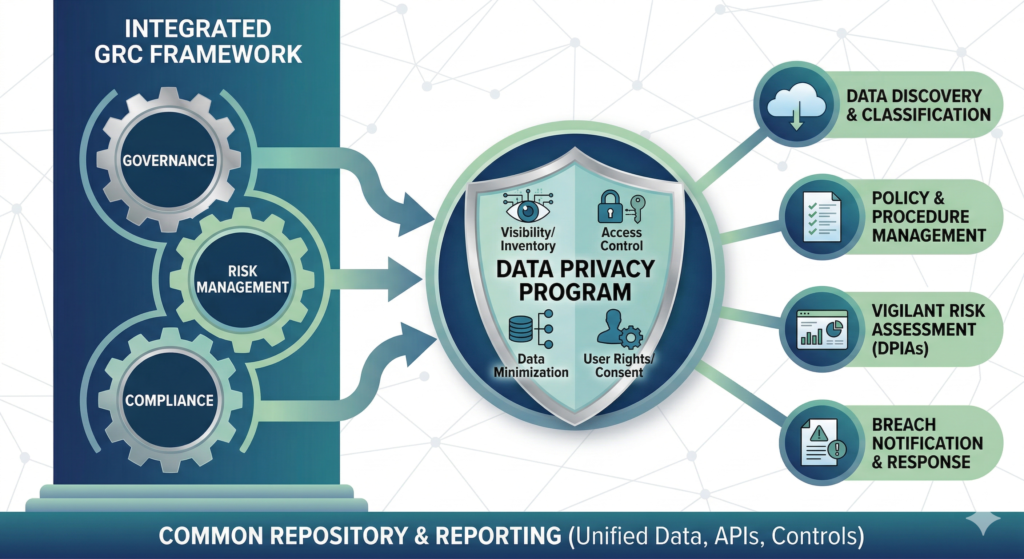
Image Description: An infographic detailing how an Integrated GRC Framework (left) feeds into and supports a dedicated Data Privacy Program (center shield). The program outputs critical capabilities like Data Discovery, Policy Management, Risk Assessments (DPIAs), and Breach Response.
Here’s how the GRC components operationalize the Data Privacy core:
1. Governance: Establishing Structure and Accountability
Governance is the foundation. An integrated program establishes clear lines of accountability, defining who owns data privacy risk from the board level down. This includes:
- Appointing a Data Protection Officer (DPO) and ensuring they report to highest management.
- Defining the organization’s ‘Privacy Charter.’
- Ensuring that privacy implications are considered before new business initiatives (Privacy by Design).
2. Risk Management: Prioritizing What Matters
A unified GRC approach brings privacy risks into the Enterprise Risk Management (ERM) framework. This is critical because privacy risk is not just regulatory (fines); it is reputational and operational.
- Integrating Data Protection Impact Assessments (DPIAs) into the standard risk assessment workflow for new projects.
- Using shared risk methodology to harmonize how privacy risks are scored against other business risks (e.g., financial, cybersecurity).
3. Compliance: Automating the Evidence
This pillar focuses on meeting specific legal obligations efficiently. A robust GRC platform maintains a dynamic controls library.
- Unified Control Frameworks: Map a single control (e.g., ‘Encryption at Rest’) to multiple regulations (e.g., GDPR Art. 32, CCPA, ISO 27001).
- Automated Evidence Collection: Move away from spreadsheet compliance. GRC platforms can automate the collection of evidence that controls are functioning correctly.
- Third-Party Risk Management (TPRM): Managing the risk of vendors that process your data. The integrated framework pushes privacy clauses and assessments directly into the vendor onboarding workflow.
The Path to Maturity: Benefits of Integration
Integrating GRC and Data Privacy is a significant undertaking, but the return on investment is immediate and substantial:
- Enhanced Strategic Decision Making: The board has a holistic view of privacy risk, allowing for balanced, data-driven strategy.
- Optimized Operations: Silos are broken, reducing redundant tasks and increasing speed, especially during data discovery or incident response.
- Proactive Regulatory Adherence: The organization shifts from reactive fire-fighting to proactive compliance, easily adapting to new data privacy laws.
- Demonstrable Trust: The ability to transparently show stakeholders, regulators, and customers exactly how their data is governed builds unwavering trust.
Data privacy is no longer a secondary compliance issue; it is a primary risk condition and a crucial element of corporate governance. By unifying GRC and Privacy functions, organizations create a framework that protects not just the data, but the organization’s integrity and future.